INCOME
INEQUALITY
Additional Research

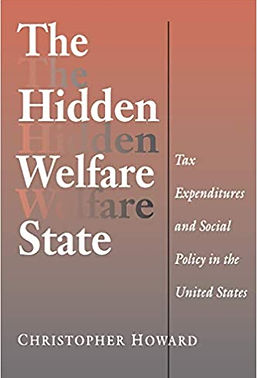
The Hidden Welfare State
Author Chris Howard, a professor at William and Mary, is a professional social policy expert who coined the phrase "hidden welfare state". In this Princeton University Press published book he details tax expenditures and their social welfare objectives that are not usually brought up.
Howard, Christopher, and Eric Howard. The hidden welfare state: Tax expenditures and social policy in the United States. Princeton University Press, 1997.
How Tax Breaks Help the Rich
Published by Vox in 2017, this video defines capital gains tax, mortgage income deductions, and charitable deductions. It gives realistic and easy to follow examples and talks about the negative implications. It counters common rebuttals and explains why this issue pertains to now.
Revealing the Hidden Welfare State
Political Scientist Matt Guardino believes that tax expenditures create income inequality. He also believes, however, that the general public is in favor of these breaks because they have limited knowledge about them. In order to prove this, he wrote this report on a survey he conducted that measured public opinion on tax expenditures, such as mortgage income deductions, based off of how much knowledge they had on the subject. He goes on to explain that by virtue of their design, these policies discourage public awareness of their mechanisms and distributive effects.
Guardino, M., and S. Mettler. “Revealing the ‘Hidden Welfare state’: How Policy Information Influences Public Attitudes about Tax Expenditures ”. Journal of Behavioral Public Administration, vol. 3, no. 1, Feb. 2020, doi:10.30636/jbpa.31.108.
Income Inequality
HIGHLIGHTS
HOW SHOULD TAX PROGRESSIVITY RESPOND TO RISING INCOME INEQUALITY?
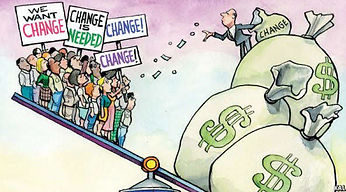
Author Jonathan Heathcote argues that a just society uses progressive taxes to combat income inequality. Recently, however, the United States has been increasing tax breaks that benefit the rich with no regard for the poor. Heathcote explores the tax breaks that are creating this and recommends his own solution to an effective tax plan that would combat income inequality.
The Tax Expenditure of the 1%
In 2012 the Tax Policy Center came out with a report on the distribution of tax expenditures which showed that capital income over salary income was the most lopsided benefit to the upper class. This article goes on to talk about the capital gains tax and its numerous benefits that are concentrated at the top of the earnings distribution. This article by the Economic Policy Institute gives a fair assessment of the capital gains tax and its adverse effects in 2012. It should be noted that the capital gains tax has lowered significantly since then, providing even more benefits to the upper class.
Heathcote, Jonathan, Kjetil Storesletten, and Giovanni L. Violante. "How Should Tax Progressivity Respond to Rising Income Inequality?." NBER Working Paper w28006 (2020).
Fieldhouse, Andrew. The Tax Expenditure of the 1%. 7 Feb. 2012, www.epi.org/blog/tax-expenditure-1-percent/.
The natural tool for a government that wants to compress income inequality is to rely on tax and transfer policies, this, however, is not happening.
In 2011, the top 1 percent of households by cash income received a whopping 75.1 percent of the benefit from the preferential treatment of capital gains and dividends.